Country guide · Cyprus

Study medicinein Cyprus

An EU medical degree, taught entirely in English, with no entrance exam — you get in on your grades and one online interview. Six years of sunshine, sea and a walled capital city. Our help is free, start to finish.

The Cyprus coastline — turquoise sea and sandstone cliffs
A cobblestone street in the old town of Nicosia
Clear Mediterranean water off the Cyprus coast
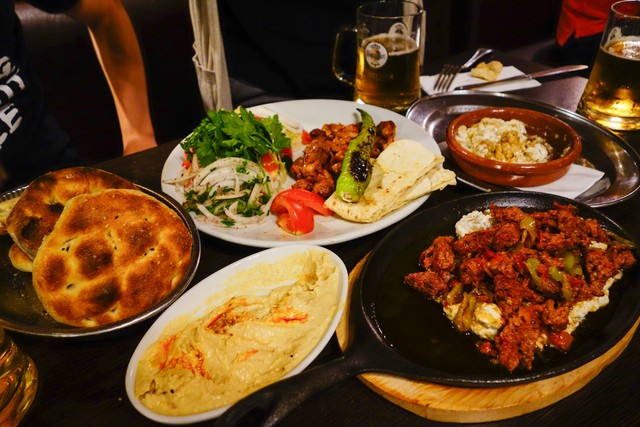
A table laid with eastern Mediterranean dishes
A vintage car parked on a narrow Nicosian street
A hillside village in the Troodos mountains
Why students choose it

The short version

0
entrance exams. Your grades decide it
100+
nationalities at the University of Nicosia
€0
what we charge you, ever
The university we work with

The University of Nicosia

UNIC teaches the full 6-year Doctor of Medicine in English on a campus at 46 Makedonitissas Avenue, with its medical facilities in Engomi. Its student body comes from more than 100 countries, and we work with them directly — so your application goes to a named contact, not a portal.

  • No entrance examYour school results and one asynchronous online interview decide it. Nothing to sit, nothing to travel for.
  • Greek from year oneGreek classes run through all six years, because your patients in Cyprus speak Greek. Most guides never mention this; it is the difference between coping and struggling in clinical years.
  • A campus that has thought about youA multi-faith prayer room, plus named Arab, South Asian, East Asian and South African culture societies inside the medical school — checkable facts, not a "welcoming atmosphere" claim.
  • Rolling admissionsNo single deadline to miss. Places fill as offers go out, so earlier genuinely is better.
Students in lab coats reviewing results on a tablet
A vintage car parked on a narrow Nicosian street
Six reasons

Why this is worth six years of your life

A cobblestone street in the old town of Nicosia
The reason most people come

No entrance exam. At all.

No written test, no exam day, no flying anywhere to sit something. Your school results and an online interview you record in your own time decide it. If exams have never been the thing that shows what you can actually do, this is the most forgiving way into medicine we know.

Clear Mediterranean water off the Cyprus coast
Winter, reinvented

Sunlight instead of darkness

Around the shortest day Nicosia still gets roughly nine hours fifty of daylight, against about six in Oslo and seven in Riga. Across six years that is not trivia — it is your evenings, your training, and very often your mood.

Medical students working together in a laboratory
A real EU degree

Recognised across Europe

The Republic of Cyprus is an EU member state, so your qualification sits inside the EU professional-recognition framework — the same route our graduates use from Slovakia, Czechia and Latvia.

An alleyway of cafe tables and chairs
You can actually live here

English genuinely works

Cyprus was under British administration until 1960 and English is still everywhere — business, universities, private healthcare, daily life. Day to day, this is far easier than Košice, Olomouc or Bydgoszcz.

A minaret against a clear blue sky
If you practise a faith

A city that has room for you

A working mosque in the old town, a multi-faith prayer room on campus, a halal butcher, English-language Catholic and Anglican services and an active Chabad centre. For a city this size, unusually well covered.

A hillside village in the Troodos mountains
Weekends

An island as your back garden

Troodos mountain villages, Mediterranean beaches, Cape Greco, Limassol. Cyprus is small enough that a free Saturday genuinely reaches all of it — and Larnaca flies direct to Oslo, London and Dubai.

Not sure your grades are enough?
Send them over and we will tell you honestly, in a day or two — before you spend anything.
Clear Mediterranean water off the Cyprus coast
36°C
Typical July and August highs. The winter is the reward; the summer is the thing to plan for.
The food

You will eat extremely well here

Cypriot cooking sits where Greek, Levantine and Turkish food meet — olive oil, lemon, herbs, charcoal, fresh vegetables and bread, rather than the potato-and-dumpling weight of Central Europe. Halloumi is the national obsession and it is grilled, fried and put in almost everything. Then there is souvlaki, slow-cooked kleftiko lamb, koupepia vine leaves and louvia, black-eyed beans with greens, lemon and oil.

What you will actually eat on a Tuesday is more ordinary: yoghurt and oats, an iced coffee somewhere between lectures, a chicken souvlaki or a Lebanese wrap for lunch, and pasta or rice at home. Cooking runs about €220–320 a month; a takeaway souvlaki is €6–10 and a casual dinner €15–25.

For Muslim students this is one of the easier cities of its size in Europe. There is a dedicated halal butchery and grocery on Trikoupi Street and around a dozen halal restaurants, including Syrian and Lebanese kitchens. Two warnings, though: never assume a Cypriot grill is halal — sheftalia and afelia are pork or caul-fat dishes — and check which side of the buffer zone a listing is on before you go.

Vegetarians have it easy here. Hummus, beans, lentils, stuffed vegetables and salads are the base of the cuisine, not an afterthought.
A table laid with eastern Mediterranean dishes
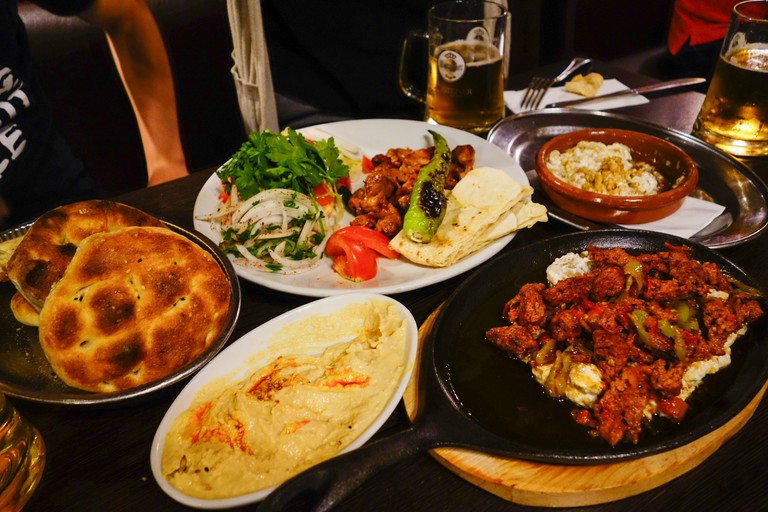
Grilled meat and vegetables on the table
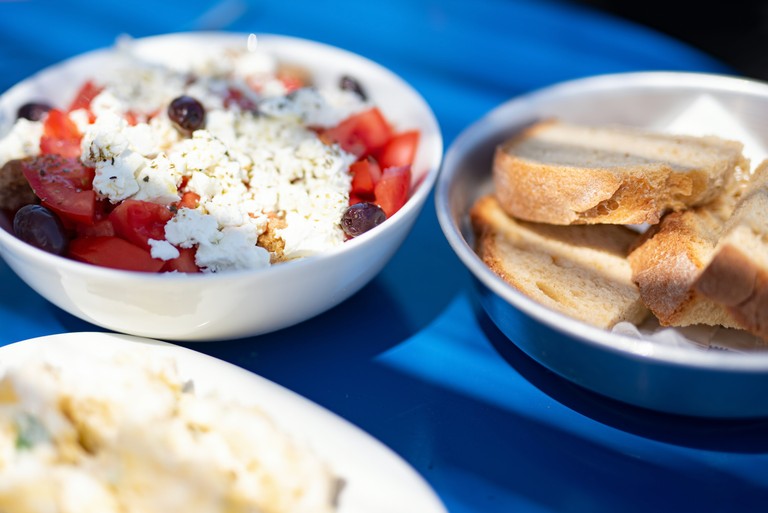
Bowls of mezze on a blue table
Faith

Where you can pray in Nicosia

Nicosia is a divided city, and on this page that matters more than anywhere else. The University of Nicosia is in the Republic of Cyprus, the internationally recognised EU member state in the south. The north is administered separately, with different rules for universities, immigration, flights and recognition — so a guide that treats "Cyprus" as one place will point you at the wrong building.

Cyprus has been Muslim and Christian for centuries, so faith is part of ordinary life here rather than something unusual.

For Muslim students
Ömeriye Mosque in the walled old town is the working mosque on the Republic side, with Friday prayer around 13:00, and the University of Nicosia has a multi-faith prayer room on campus. There is a halal butchery and grocery on Trikoupi Street and around a dozen halal restaurants. ⚠️ Selimiye and Haydarpaşa, which most lists name, are across the buffer zone in the north.
For Christian students
Holy Cross by Paphos Gate holds Catholic Mass in English, and St Paul's Cathedral is the centre of Anglican life on the island with English services. Greek Orthodox churches fill the old town — St John's Cathedral and Faneromeni among them — and Orthodox Easter is the biggest event of the Cypriot year.
For Jewish students
Chabad of Nicosia runs synagogue services, kosher food, Shabbat meals and Torah classes, with the wider Cyprus community hub in Larnaca about forty minutes away.
For Hindu students
There is a real South Asian community in Nicosia and a South Asian Culture Society inside the medical school, but no dedicated temple in the city that we can confirm. Tell us and we will connect you with the community before you arrive.
For Sikh students
Cyprus has an established Sikh community — about 2,264 people at the 2021 census, the island's fourth-largest religious group — and Gurdwara Sangatsar Sahib near Larnaca, roughly forty minutes from Nicosia, with Sunday programmes and langar.
A minaret against a clear blue sky
A whitewashed church with a blue dome
A stone alleyway in the walled old city
Living there

What six years in Nicosia actually costs

Housing sets your budget. A room in a shared flat runs €350–550, a better room near Engomi or Agios Dometios €450–650, a modern studio €650–900. Be warned that university-linked residences are not the cheap option — closer to €880–1,010 a month.

Realistically: about €850–1,000 a month sharing frugally, €1,150–1,400 for normal student life, €1,700–2,200 living alone comfortably. A 30-day student bus pass is €29.80, coffee about €3.30, a beer €4–5.

The cost nobody warns you about is electricity. Air conditioning through a Cypriot summer is not a luxury, and a cheap-looking top-floor flat in March will punish you in July — always ask what the rent includes before you sign.

Two honest things: Nicosia is inland, so there is no beach in the capital. And there is no railway anywhere in Cyprus — the island runs on buses and cars.
A bright apartment with a wide view
Friends sharing a meal around a table
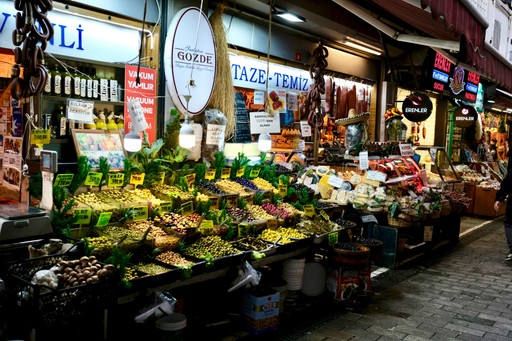
A market stall of spices and dried goods
Students in lab coats reviewing results on a tablet
6 years
The full Doctor of Medicine, taught in English, with Greek classes running the whole way through.
See it for yourself

Six years here, from the air

Clear Mediterranean water off the Cyprus coast
Admission

What you actually need, by where you're from

There is no entrance exam. Admission rests on your school results, your science subjects and an online interview — plus proof of English, which Norwegian students do have to provide here — unlike at some of our other universities.

🇳🇴 Norwegian students
A vitnemål with minimum 4.0 overall and 4.0 in your sciences, including Biology plus one more science (Chemistry, Physics or Maths). Cyprus is the one place we work with where your snitt genuinely decides it.
🇬🇧 UK students
A-Levels including Biology and one further science, alongside your GCSEs.
🌍 International students
Any 12-year school-leaving qualification — IB, Abitur or your country's equivalent — including Biology and one more science. We check yours before you apply.
Everyone: proof of English
IELTS 6.5 (6.5 writing, 6.0 other bands), Password Skills Plus, TOEFL iBT 79, GCSE grade 5 or IB SL 5. ⛔ Unlike UMCH, Norwegians are not exempt — sort this early, it delays more Cyprus applications than anything else.
The interview
Asynchronous and online: you record it in your own time. We run a practice round with you first. There is no written exam at any stage.
Medical students working together in a laboratory
We do the paperwork with you, free
Transcripts, translations, the English certificate and the interview practice — all of it, at no cost to you.
The details

Everything on one line

Degree
Doctor of Medicine (MD)
Duration
6 years
Language
100% English
Entrance exam
None
Tuition
€22,000–24,000 / year
Living costs
≈ €1,150–1,400 / month
🇳🇴 Norwegian minimum
4.0 overall + 4.0 sciences
English proof
IELTS 6.5 or equivalent
Intake
September · rolling
Direct flights
Oslo · London · Dubai
All six side by side

How this compares with the other five

No university will ever publish this table, because it points at cheaper competitors. We will — it is the honest way to choose.

CountryUniversityEntrance examTuition / yearGetting to OsloMidwinter daylight
🇸🇰 SlovakiaUPJŠ KošiceBiology + Chemistry only€13,000Via Warsaw or Vienna8h20
🇨🇿 CzechiaPalacký OlomoucOnline, instant result€12,500Via Prague, 2h15 by train8h12
🇩🇪 GermanyUMCH HamburgOnline + interview€25,000–34,800Direct, 1h257h30
🇱🇻 LatviaRSU RigaNone — grades decide€13,500Direct, 1h307h00
🇵🇱 PolandNCU Bydgoszcz50 questions + oral≈ €14,700Via Gdańsk, 1h25 by train7h36
🇨🇾 CyprusYou are hereUNIC NicosiaNone — grades decide€22,000–24,000Direct, 4h359h50
Slovakia
UPJŠ Košice
Entrance exam
Biology + Chemistry only
Tuition / year
€13,000
Getting to Oslo
Via Warsaw or Vienna
Midwinter daylight
8h20
Czechia
Palacký Olomouc
Entrance exam
Online, instant result
Tuition / year
€12,500
Getting to Oslo
Via Prague, 2h15 by train
Midwinter daylight
8h12
Germany
UMCH Hamburg
Entrance exam
Online + interview
Tuition / year
€25,000–34,800
Getting to Oslo
Direct, 1h25
Midwinter daylight
7h30
Latvia
RSU Riga
Entrance exam
None — grades decide
Tuition / year
€13,500
Getting to Oslo
Direct, 1h30
Midwinter daylight
7h00
Poland
NCU Bydgoszcz
Entrance exam
50 questions + oral
Tuition / year
≈ €14,700
Getting to Oslo
Via Gdańsk, 1h25 by train
Midwinter daylight
7h36
CyprusYou are here
UNIC Nicosia
Entrance exam
None — grades decide
Tuition / year
€22,000–24,000
Getting to Oslo
Direct, 4h35
Midwinter daylight
9h50

Midwinter daylight is the shortest day of the year, for comparison Oslo gets about six hours. Tuition is the published annual rate for students starting in 2026/27 and we confirm your exact figure in writing before you commit.

Questions

The things people actually ask us

Can I study medicine in English in Cyprus?
Yes. The University of Nicosia teaches the full 6-year Doctor of Medicine entirely in English in the Republic of Cyprus, an EU member state. European University Cyprus also runs an English-taught 6-year MD. Neither offers dentistry in English.
Is there an entrance exam for medicine in Cyprus?
No, and it is the main reason students choose Cyprus. Admission rests on your school results, your science subjects and an asynchronous online interview you record in your own time. There is no written entrance exam at any stage.
What grades do Norwegian students need?
A vitnemål with a minimum 4.0 overall and a minimum 4.0 in your sciences, including Biology plus one further science — Chemistry, Physics or Maths. Cyprus is the one place we work with where your snitt genuinely decides it; everywhere else an entrance exam does.
Do I need IELTS?
Yes, and Norwegian students are not exempt here, unlike at some other universities we work with. IELTS 6.5 (6.5 writing, 6.0 other bands), Password Skills Plus, TOEFL iBT 79, GCSE grade 5 or IB SL 5 all count. Sorting this early is the single best thing you can do to keep your application moving.
How much does it cost to study medicine in Cyprus?
Published tuition sits in the €22,000–24,000 per year range, and we confirm your exact figure in writing before you commit rather than printing one number and hoping. Living in Nicosia costs roughly €1,150–1,400 a month for normal student life, or €850–1,000 if you are frugal.
Is Nicosia divided, and does it matter?
Yes to both. Nicosia is split by the UN buffer zone. The University of Nicosia is in the Republic of Cyprus, the EU member state in the south. Universities in the north operate under a separate administration with different recognition, immigration rules and flights. Never treat Cyprus as one place when comparing medical schools.
Is the degree recognised in Norway and the EU?
The Republic of Cyprus is an EU member state, so the qualification falls under the EU professional-recognition framework in Directive 2005/36/EC — the route Norwegian graduates use to apply for Helsedirektoratet authorisation. Recognition in any specific country depends on that country's regulator, and we check yours with you.
Do I need Greek?
Not to be admitted and not for lectures — the programme is fully in English. But your patients speak Greek, so the University of Nicosia runs Greek classes throughout all six years. Students who treat them as optional find the clinical years much harder than they need to be.
Is there halal food and a mosque in Nicosia?
Yes. Ömeriye Mosque in the walled old town is the functioning mosque on the Republic side, with Friday prayer around 13:00, plus a halal butchery and grocery on Trikoupi Street and around a dozen halal restaurants. The university has a multi-faith prayer room on campus. Do not trust directory listings without checking which side of the buffer zone a business is on.
What is the weather actually like?
The winter is why you come and the summer is what you plan for. January highs are around 14°C with nearly ten hours of daylight at midwinter, against about six in Oslo. July and August highs are around 36°C, with official climatology approaching 38°C and 40°C spells happening — so a flat with effective air conditioning matters more than almost any other housing decision you will make.
A stone alleyway in the walled old city
Grilled meat and vegetables on the table
A whitewashed church with a blue dome
An alleyway of cafe tables and chairs
Medical students working together in a laboratory
Iced coffee — the drink of a Cypriot summer
A minaret against a clear blue sky
A bright apartment with a wide view
A market stall of spices and dried goods
Friends sharing a meal around a table

Medicine in Cyprus, without an entrance exam

Send us your grades and we will tell you honestly where you stand — no exam to sit, no agency fees, no pressure.

Medently
© 2026 Medently Malook and Medently Mussarat. All rights reserved.