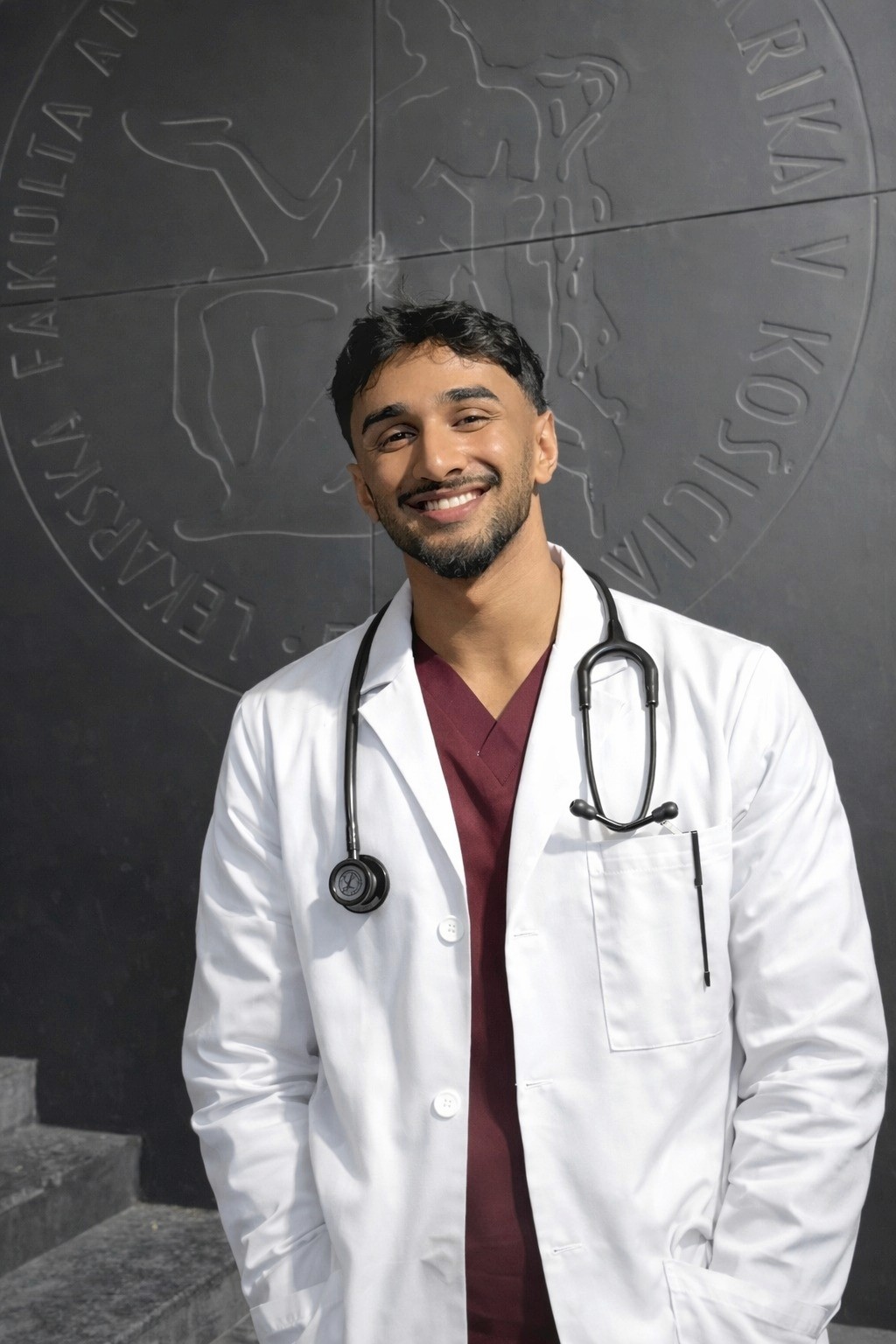
International students can study medicine in Europe in English at UPJŠ Košice (Slovakia), UPOL Olomouc (Czech Republic), and UMCH Hamburg (Germany). All three run 6-year EU-accredited General Medicine (MUDr.) programmes taught fully in English, with tuition between €12,500 and €25,000 per year, and degrees recognised by the GMC, Helsedirektoratet, ECFMG, and medical boards worldwide.
Studying medicine abroad does more than land you a doctor's title — it changes who you are. For aspiring doctors, choosing to study medicine in English in Europe broadens cultural horizons, builds genuine self-reliance, and forces a level of maturity that simply cannot be replicated by living at home. International students gain a measurable edge in the global job market thanks to that mix of cross-border training and life experience — every NHS consultant, every Helsedirektoratet authoriser, every US Match committee can spot it on a CV.
For the last two decades, more and more aspiring doctors have chosen English-taught medical programmes in Europe over the lottery system at home. For some, the trigger is brutal admissions back home where eleven applicants chase every UK seat. For others, it is money — an English-taught MD in Central Europe costs less than a single year of US tuition, with no loan-debt life sentence waiting on graduation day.
Whatever your situation, choosing Europe to study medicine is not a backup plan and should never be framed as one. The faculties at our partner universities — UPJŠ Košice, UPOL Olomouc, and UMCH Hamburg — deliver the same EU-standardised curriculum as Western European medical schools, train you in modern university hospitals, and award you a degree the GMC, Helsedirektoratet, and ECFMG recognise without hesitation. You qualify as a fully practising doctor anywhere in the world.
🏛️ Where Can You Study Medicine in English in Europe?
Medently partners with three of the strongest English-taught medical faculties in Central Europe. Every partner is fully accredited, listed in the World Directory of Medical Schools, and runs a 6-year General Medicine programme entirely in English. Each has its own personality — pick the one that fits the kind of student you are.
UPJŠ — Pavol Jozef Šafárik University, Košice, Slovakia. €13,000/year. In-person multiple-choice entrance exam drawn from a fixed, pre-published pool of 1,200 biology and chemistry questions. Two exam dates each year (17 June and 12 August). The largest international community of our three partners, with strong Norwegian, UK, German, and Middle-Eastern student cohorts, an active university hospital next to campus, and one of the most accommodating transfer systems in Europe.
UPOL — Palacký University Olomouc, Czech Republic. €12,500/year. Online entrance exam covering biology, chemistry, and a logic component, sat across three July dates. Olomouc is a classic student town with affordable housing, walkable historic centre, and a deep medical research tradition stretching back centuries. One sitting per year — be ready when you apply.
UMCH — University of Targu Mureș Hamburg branch, Germany. €25,000/year. The only English-taught medical programme in Germany at this level — no German required to enrol. Online entrance exam, hybrid course delivery for the preclinical years, and full integration into Germany's hospital system from Year 4. Western European salary potential if you stay.
Compare All Three Universities →
📋 What Are the Entry Requirements?
The admissions mix differs slightly between universities, but the core 2026/2027 checklist is essentially the same. Crucially: no UCAT, no BMAT, no MCAT, no UCAS personal-statement marathon.
High school diploma — GCSE/A-Levels, IB, Norwegian vitnemål, UAE secondary, or any country equivalent — apostilled and translated into Slovak, Czech, or German.
English proficiency — native background, an accepted certificate (IELTS, TOEFL, Cambridge), or an interview assessment at the university.
Entrance exam in biology and chemistry — sometimes plus physics or logic for UPOL. UPJŠ publishes its full 1,200-question pool in advance, so every possible exam question is visible months before you sit. Drill them with our free UPJŠ flashcards.
Motivation interview at UMCH — a short online conversation evaluating your reasons for entering medicine. UPJŠ and UPOL do not require this.
Valid passport and standard application paperwork.
Modest application fee — €30 at UPJŠ, similar at UPOL, paid directly to the university.
Crucially, your home-country GPA does not gatekeep you the way UCAT or MCAT does. Pass the science entrance exam and you have a seat. Past grades, missed A-level papers, and unfortunate Norwegian vitnemål results all stop mattering the moment you walk out of that exam.
💶 How Much Does It Cost to Study Medicine in Europe?
Tuition for English-taught medicine at our partner universities ranges from €12,500 to €25,000 per year. These prices reflect the geographic and economic position of each country — not the standard of teaching. Medicine is taught the same way everywhere in the EU because EU Directive 2005/36/EC forces a single minimum curriculum on every faculty.
Here is the real annual outlay at our three partner universities for 2026/2027, with realistic living-cost estimates:
University | Tuition / Year | Living / Month | Total / Year |
|---|---|---|---|
UPOL — Olomouc, Czechia | €12,500 | €500–€650 | ~€18,500 |
UPJŠ — Košice, Slovakia | €13,000 | €550–€700 | ~€19,500 |
UMCH — Hamburg, Germany | €25,000 | €900–€1,200 | ~€36,500 |
For Norwegian students, all three universities are fully covered by Lånekassen — both the tuition loan and the monthly living stipend. The vitnemål is enough, your Helsedirektoratet pathway is documented, and you graduate ready to start LIS1 in any Norwegian county. For UK, UAE, and other international applicants, the comparison is even starker: a six-year MD at UPJŠ costs less than a single year of private medical school in the UK or the US, and there is no debt-funded interest spiral waiting on graduation day.
One reminder: lower tuition does NOT mean lower quality. Prices reflect country-level economics, not curriculum standards. The hospital you train in at UPJŠ or UPOL operates on identical EU clinical-hour requirements as any German or French hospital.
🌍 Where Is the Medical Degree Recognised?
All three of our partner faculties operate under EU Directive 2005/36/EC, the law forcing every European medical faculty to teach the same minimum hours, clinical rotations, and curriculum standard. The result: your MUDr. is treated as legally equivalent to any other EU medical degree, everywhere it matters.
United Kingdom (GMC): direct registration after submitting your diploma, transcripts, and English proof. EEA-trained graduates qualify for the GMC's direct registration pathway; UKLMA is the new licensing exam route opening in 2026/2027.
Norway (Helsedirektoratet): autorisasjon as a fully qualified doctor (lege) once your diploma is submitted and verified. LIS1 placements open after authorisation. Lånekassen-funded throughout studies.
Ireland (RCSI / Medical Council of Ireland): recognition for full registration via the standard PRES pathway.
United States (USMLE): all three universities are listed in the World Directory of Medical Schools with active ECFMG sponsorship. Sit Step 1 and Step 2 CK during your studies, then enter the residency Match.
Canada (MCCQE): Medical Council of Canada Qualifying Examination Part I and II for licensure, plus CaRMS residency match.
Australia (AMC): Australian Medical Council clinical examination, then internship year and full registration.
UAE / GCC (DHA, MOH, HAAD): standard verification process, popular pathway for our Emirati and Saudi alumni.
⭐ 10 Reasons to Choose UPJŠ, UPOL, or UMCH
Here is why students from Norway, the UK, the UAE, Germany, and across Europe pick our three partner faculties year after year:
1. Globally recognised, EU-protected degrees — EU Directive 2005/36/EC means your MUDr. is legally equivalent to a UK or German MD. The GMC, Helsedirektoratet, ECFMG, MCC, AMC, and DHA all accept our graduates.
2. Hundreds of English-taught seats at our three universities — pick the campus, the city, and the exam format that fits you, and never feel like one of 50,000 in a UCAS funnel.
3. Less competition for entry — international tracks are sized for international demand, not a national bottleneck. Norwegian and UK applicants do not compete head-to-head with domestic Slovak or Czech students.
4. Apply to all three simultaneously — no UCAS-style 4-application cap. Hedge your application portfolio and pick where you get the best offer.
5. No UCAT, BMAT, or MCAT — a single biology + chemistry science entrance exam replaces every aptitude test you might dread. UPJŠ's exam draws from a published pool of 1,200 questions, so you can see every possible answer in advance.
6. Past GPA does not gatekeep you — pass the exam and you are in. A single bad A-level paper, weak Norwegian average, or unforeseen secondary-school grade does not block your medical career.
7. Genuinely affordable tuition — a six-year degree at UPJŠ or UPOL costs less than two years of US tuition, with no quality compromise.
8. Lånekassen-eligible — Norwegian students get full tuition loans and living stipends at all three universities, identical to studying at home.
9. Established international communities — hundreds of UK, Norwegian, German, Emirati, and Saudi peers already on campus. You will not be alone, and you will probably make friends for life.
10. Modern teaching hospitals and tech — university-owned hospitals attached to each faculty, full simulation labs, daily small-group teaching with patients from Year 3 onwards.
📚 How Are Medical Courses Structured in Europe?
English-taught medicine in Europe is built for high school graduates who can apply right after their A-Levels, IB, Norwegian vitnemål, or 12th-grade equivalent. You do not need a bachelor's degree, a year of shadowing, an MCAT score, or two letters of recommendation. Pass the entrance exam and you start medical school in September.
All three of our partner programmes follow the standard 6-year EU MUDr. format:
Years 1–3: pre-clinical theory ➔ Years 4–6: clinical rotations in teaching hospitals
Pre-clinical years (1–3)
Anatomy, biochemistry, physiology, histology, microbiology, pharmacology, pathology, immunology. Heavy theoretical foundations with daily small-group seminars (cohorts of 6–12 students), cadaver dissection, microscope sessions, and simulation-lab patient encounters. By the end of Year 3, you can read an ECG, conduct a basic physical exam, take a structured patient history, and reason through a differential diagnosis.
Clinical years (4–6)
Internal medicine, general surgery, paediatrics, obstetrics & gynaecology, neurology, psychiatry, anaesthesiology, emergency medicine, family medicine, and surgical subspecialties. You rotate through the university teaching hospitals and treat real patients under expert supervision. By graduation you have logged hundreds of clinical hours, scrubbed into surgeries, delivered babies, run resus, and managed your own ward patients alongside specialist teams.
At graduation you receive a Doctor of General Medicine (MUDr.) and you can immediately start junior doctor work in your country of licensure — FY1 in the UK, LIS1 in Norway, intern in the US match, internship in Australia, or residency in the UAE.
🚀 How to Gain Admission — The Medently 8-Step Process
Studying medicine in Europe is one of the most straightforward pathways into the profession if you know the steps. Here is the simple 8-step process Medently uses with every applicant — and yes, we handle every step for you, free of charge, because we are paid by our partner universities directly.
1. Choose your university: Pick UPJŠ, UPOL, or UMCH — or apply to all three at once. Hedging is encouraged.
2. Apostille and translate your documents: High school diploma + transcripts. Allow 4–8 weeks; this is the #1 reason students miss a seat.
3. Drill the entrance exam: Spend 8–12 weeks with our free UPJŠ flashcards, sample tests, and mock simulations.
4. Submit your application: Medently handles every form, every deadline, every document upload.
5. Sit the entrance exam: In-person in Košice for UPJŠ, online for UPOL and UMCH.
6. Receive your offer: Decisions arrive within days, sometimes hours, of the exam.
7. Visa or residence permit (non-EU applicants): Medently coordinates embassy paperwork and tracks your application until the stamp lands in your passport.
8. Arrive in September: White coat ceremony, induction, scrubs, and the start of Year 1.
🤔 How Do You Pick Between UPJŠ, UPOL, and UMCH?
Most Medently applicants narrow it down on three factors:
Exam format: If you like predictable, memorisable content with a published question pool, UPJŠ is your pick. If you prefer testing concepts and logic over rote memorisation, UPOL fits better. UMCH is the best fit if you want a hybrid format with a motivation interview.
Cost: UPOL is the cheapest tuition at €12,500. UPJŠ is €13,000. UMCH is €25,000 but offers Germany-based clinical years.
City and lifestyle: Košice is Slovakia's second-largest city, vibrant and walkable with active Norwegian and UK communities. Olomouc is a classic student town with low costs and deep tradition. Hamburg is one of Western Europe's biggest cities with everything that implies — cost, culture, career networks.
💬 Get Started Today
Medently was built by active medical students at UPJŠ Košice who walked this exact path. Our advisory is 100% free — we are funded by our partner universities, not by you. Traditional study agencies charge €1,500–€5,000 for the same work; we charge zero. From your first message to your first lecture in September, every step of your application is on us.
Every Medently student gets free entrance-exam flashcards, document handling, and direct chat with current students at UPJŠ, UPOL, and UMCH. No fees, no hidden costs.
Ready to apply to medicine or dentistry in Europe?
Talk to active students. 100% free advisory from Medently.



