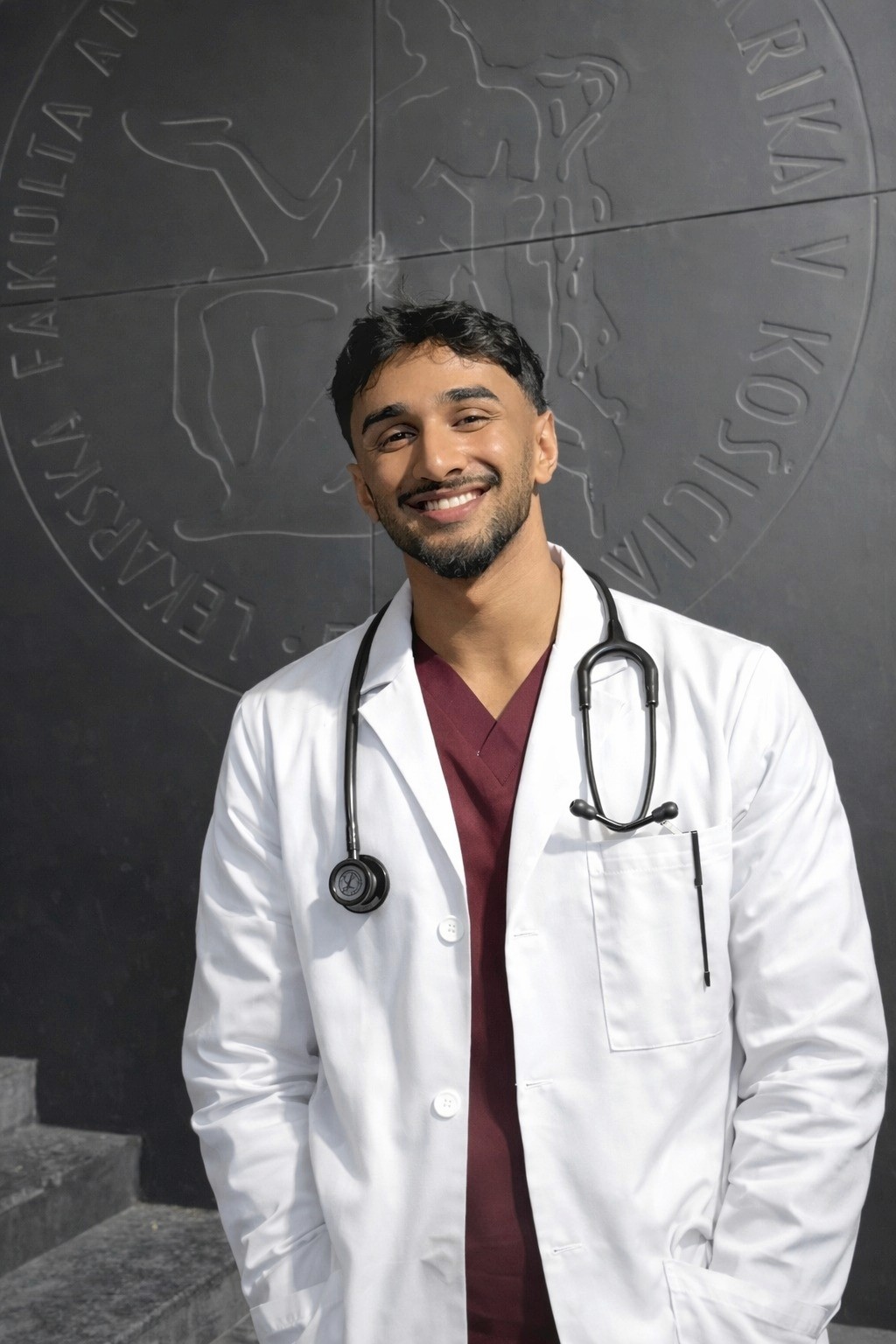
The UPJŠ Košice entrance exam for the English-taught General Medicine and Dentistry programs is a written, multiple-choice test in Biology and Chemistry — no interview, no essay. Questions come from the university's official published question booklet, so structured prep beats raw talent. See the UPJŠ program →
I still remember refreshing my results page like it owed me money. So if you're googling 'upjs entrance exam' at 1am, slightly stressed, slightly excited — I get it. I'm Saif, a med student, and I went through an entrance exam like this myself. Here's the honest version, not the brochure version.
What the UPJŠ entrance exam actually is
It's a written, multiple-choice test in two subjects: Biology and Chemistry. That's it. No interview, no essay, no 'tell us your life story' — just you, a question sheet, and a few hundred MCQs.
The exam is drawn from the official published UPJŠ question booklet, so mastering that specific pool matters more than raw talent.
How hard is the UPJŠ entrance exam, really?
Fair, but not a joke. Questions sit around advanced high-school / early-university level. Nothing is designed to trick you — the challenge is breadth, not obscurity. Biology covers cell biology, genetics, human anatomy and physiology; Chemistry runs general, inorganic, and organic.
The people who do well started early and chipped away — a chapter here, a question set there — instead of trying to inhale two syllabuses in a weekend.
How to actually prepare
Get the official UPJŠ question booklet. This is the single most underrated move: the university publishes the pool the exam is drawn from, so your job is less 'learn all of biology' and more 'master this specific list.' Treat it like scripture.
Then drill it actively. Re-reading notes feels productive and teaches you almost nothing — testing yourself, getting things wrong, and fixing the gaps is where the learning lives. That's exactly why we built Medently flashcards around the official UPJŠ question pool: spaced repetition on the facts that refuse to stick.
One more thing: do the questions in English even if it's not your first language. 'Medulla oblongata' shouldn't be a surprise on exam day.
When does it happen?
Applications generally open in winter and run through spring, with the exam usually held around June for that autumn's intake. Dates shift year to year, so always check the current admissions cycle — deadlines sneak up faster than you'd think when you're juggling finals back home.
Why Košice is worth it
The city is genuinely lovely and cheap to live in, and the degree travels. UPJŠ is an EU university, so the diploma is recognised across the EU/EEA under EU Directive 2005/36/EC — including Norway, where you apply for autorisasjon through Helsedirektoratet. Our partner UPOL in Olomouc works the same way.
The 2 exam routes at a glance
Both universities admit through the same Biology and Chemistry entrance format, and both degrees are EU-recognised under Directive 2005/36/EC.
Košice, Slovakia: written MCQ exam in Biology and Chemistry
- Written multiple-choice test in Biology and Chemistry
- No interview, no essay
- Sat fully in English
- Questions drawn from the official published booklet
- Medently flashcards built around the official question pool

Olomouc, Czechia: same subjects, same EU recognition
- English-taught, same as UPJŠ
- Entrance subjects: Biology and Chemistry
- EU-recognised degree under Directive 2005/36/EC
- Recognition works the same way as UPJŠ

| UPJŠ Košice | UPOL Olomouc | |
|---|---|---|
| Country | Slovakia 🇸🇰 | Czechia 🇨🇿 |
| Language | English | English |
| Entrance subjects | Biology + Chemistry | Biology + Chemistry |
| EU-recognised degree | Yes (2005/36/EC) | Yes (2005/36/EC) |
If you want a hand
Figuring this out alone is doable, but it's a lot — which is why we built Medently. My co-founder Dr. Dylan is an actual doctor, I'm an actual med student, and we help people get into medicine and dentistry at universities like UPJŠ, UPOL, UMCH and RSU in Riga. It's free. No agency fees, no catch.
Every Medently student gets free document handling, entrance-exam flashcards where there is an exam, and direct chat with current students at UPJŠ, UPOL, UMCH and RSU. No fees, no hidden costs.
Ready to apply to medicine or dentistry in Europe?
Talk to active students. 100% free advisory from Medently.
