You can study dentistry in Riga in English at Rīga Stradiņš University (RSU). It is a 5 year DDS, tuition is €15,500 per year, and there is no entrance exam. What there is instead is scarcity: only 32 dental seats per intake, and a real chemistry and biology bar. Applications for the February intake open 1 September and studies begin 2 February 2027. See the RSU dentistry programme →
Thirty two seats. That is the entire dentistry class at RSU for an intake, for the whole world.
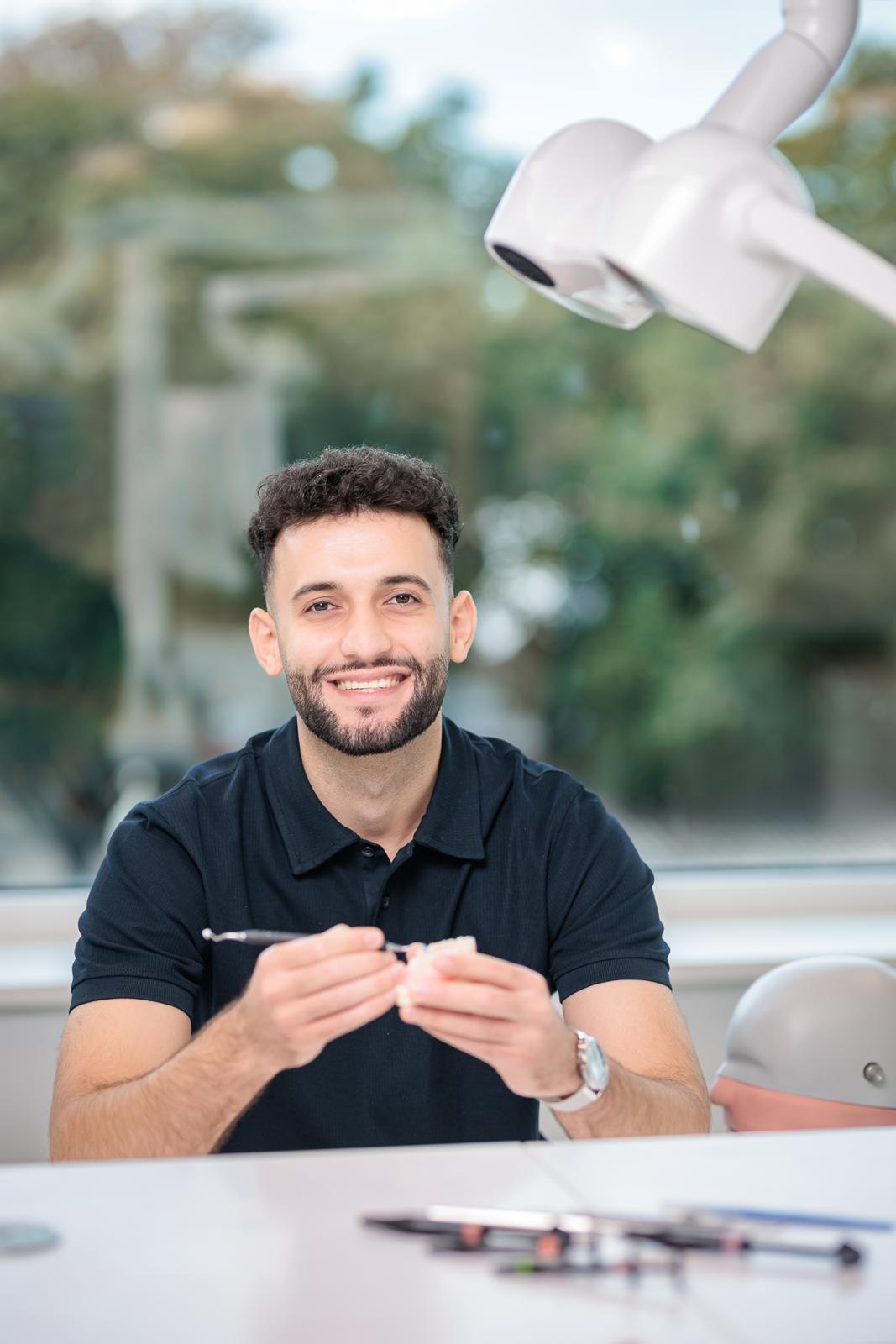
I am Omar, a dental student abroad, and I want to lead with that number because every other guide leads with the nice photos. Dentistry is the hardest seat in European healthcare education to win. Norway takes a few dozen a year. The UK turns away thousands. And in Riga, a university with no entrance exam at all still has a class you could fit in one lecture room.
None of that means it is out of reach. It means the thing that decides it is not talent on a test day, it is whether your application was strong and whether it was early. Here is exactly how it works.
No exam, but a higher bar than medicine
Here is the thing most people get wrong about RSU. They read "no entrance exam" and assume dentistry is the soft option. It is the opposite. Because there is no test to prove yourself on, the school record has to do all the proving, and for dentistry RSU raises where that record has to sit.
Medicine at RSU wants chemistry or biology at 70%. Dentistry wants 80% in chemistry or biology, and RSU's own wording gives priority to applicants who have both. With 32 places, priority is not a formality. It is the queue.
| Requirement | Medicine (MD) | Dentistry (DDS) |
|---|---|---|
| Length | 6 years | 5 years |
| Tuition | €13,500 / year | €15,500 / year |
| Seats, February intake | 240 | 32 |
| Chemistry | 70% (or biology) | 80% |
| Biology | 70% (or chemistry) | 80% |
| English | 70% | 70% |
| Mathematics | Compulsory | Compulsory |
| Entrance exam | None | None |
Read the seats row again. Medicine has 240 places, dentistry has 32. That ratio, more than any grade threshold, is the real story of dental admissions in Riga.
No entrance exam does not make dentistry the soft option: with 32 seats and an 80% chemistry and biology bar, a clean transcript submitted early does all the proving.
What you actually need to submit
The full document list is not long, but every item is a place an application can die. These are the ones we watch hardest for dental applicants.
- High school diploma and grade list — your vitnemål, A levels, IB or equivalent, showing every subject and grade. If it is not in English it needs a certified paper translation with the translator's stamp and signature.
- Chemistry or biology at 80% — one science clears RSU's published bar, but with only 32 seats the applicants who bring both go to the front of the queue. If one of yours is borderline, tell us early, because there are legitimate ways to strengthen a file and none of them work in November.
- English — If you finished high school in English, for example A levels, the IB or an American or Australian curriculum, you need no test, just a school letter confirming English was the language of teaching. EU and EEA applicants with very good English grades normally need no test either. Other applicants from outside the EU and EEA must submit a test result such as IELTS 6.0, and the application is not processed without it.
- No failing grades — anywhere on the diploma. This is an automatic rejection and it has nothing to do with dentistry specifically.
- Two recommendation letters and one motivation letter — on RSU's own forms, signed by the referee, no older than two years, and never from family, friends or anyone else with an interest in your application.
- Passport, application fee receipt and a photo — the administrative half, which is boring right up until it delays you by three weeks.
If you are applying from outside the EU and EEA there is one extra step: RSU runs a mandatory recorded online motivational interview for non EU and EEA citizens. It is a conversation about why you want this, not a test, but refusing it ends the application. EU and EEA citizens do not do this.
What five years of dentistry in Riga costs
Dentistry costs more than medicine everywhere, because you are being taught in clinics with equipment. Here is the full degree cost across the dental programmes we work with, so you can see where Riga sits.
At today's prices Riga is the most expensive of the three, by roughly €10,000 across five years. These are current-year fees, not locked quotes. What that buys is the only one of the three with no entrance exam and a February start. Whether that trade is worth it depends entirely on your grades and your patience, and we will tell you honestly which way it falls for you.
Beyond tuition, budget for these:
- Application fee, €100 — paid to RSU, non refundable.
- First tuition payment — due within two weeks of the registration date on your offer, and RSU may set a shorter deadline late in the window.
- Living in Riga, budget €1,200 a month — that is RSU's own recommendation including accommodation. Sharing and a hostel room bring it well down, and Riga is 47% cheaper than Oslo overall.
- Medently, €0 — we are paid by universities. Students never pay us anything.
Where you will actually train
RSU's campus sits on Dzirciema iela with modern lecture halls, labs and the METC simulation centre. For dentistry specifically, the main clinical partner is the RSU Institute of Stomatology, which RSU describes as the largest dentistry clinic in Latvia. Preclinical work happens in simulation labs on mannequins and 3D devices before you go anywhere near a patient.
The university was founded in 1950, is named after the surgeon Pauls Stradiņš, and teaches over 12,000 students from more than 80 countries. Roughly one in four is international, which is why the English taught programmes do not feel like a bolt on. The programme is accredited until 28 May 2030.
What living in Riga costs
Riga is the biggest capital in the Baltics at just under 590,000 people, with a UNESCO listed Old Town and an Art Nouveau quarter covering nearly a third of the city centre. Latvia ranks 16th in the world for English proficiency, so daily life in English is genuinely comfortable. Oslo is an hour and a half away non stop, with fares starting around €46 one way.
On money, be careful which number you trust. RSU tells international students to budget at least €1,200 a month including accommodation, and publishes its own split of about €1,050 if you share and €1,500 if you live alone. Latvia's national study portal quotes €450 to €700. The gap is entirely about how you live.
Budget for €1,200 and let the hostel and a flatmate bring it down. That is a much better surprise than the other direction.
The honest version: Riga is not exotic and it is not a compromise. It is a normal European capital where a dental degree costs less than a Norwegian deposit on a flat, and where nobody asks you to sit an exam to prove you deserve it.
The February 2027 timeline
Applications for the February intake open on 1 September 2026 and the EU and EEA window runs to 1 December 2026. Studies begin 2 February 2027, with Welcome Week from 27 to 30 January.
- Between now and September. Get your grade list translated, confirm your chemistry and biology percentages, and get the RSU letter forms to your teachers. Teachers are hard to reach in December and easy to reach now.
- 1 September. The e-Admissions portal opens. Register, upload, pay the €100 fee.
- Straight after submitting. Email RSU your application number. Processing does not start until you do, and with 32 seats a lost week is a real cost.
- Within two months of a complete file. The decision comes back. Rolling admissions genuinely reward the early.
- January 2027. Registration fee, first tuition, housing, flight, Welcome Week.
- 2 February 2027. You start.
With a class this small, "apply early" stops being generic advice and becomes the strategy. A complete file in September is competing for a full 32 seats. The same file in late November is competing for what is left.
Practising as a dentist afterwards
Latvia is an EU member state and RSU is a state university, so a Latvian dental degree is recognised across the EU and EEA under the professional qualifications directive. That is the same route dentists trained in Slovakia, Czechia or Sweden use.
For Norway the authorisation goes through Helsedirektoratet, the same body that authorises doctors, with its own dental track. For the UK, registration runs through the General Dental Council and the rules for non UK qualifications changed after Brexit, so if the UK is your endpoint check the current GDC requirements directly before you commit. Do not take a blog's word for it, ours included.
FAQ
Is there an entrance exam for dentistry in Riga?
No. RSU admits to dentistry on documents. Your diploma, grade list, science percentages, English, letters and fee are the whole assessment. Applicants from outside the EU and EEA additionally sit a recorded online motivational interview, which is a conversation rather than a test.
How hard is it to get into RSU dentistry?
Harder than the "no exam" headline suggests. There are 32 seats per intake, chemistry or biology is wanted at 80%, and RSU prioritises applicants who have both. It is not a lottery and it is not impossible. It rewards a clean transcript submitted early.
How much does dentistry in Riga cost in total?
€15,500 per year, which at today's price is €77,500 across five years, plus a €100 application fee and a one-off €1,800 registration fee. We go through the full payment schedule with you before you commit. For living, RSU recommends budgeting at least €1,200 a month including accommodation, and a hostel room plus a flatmate brings that down considerably.
What if my chemistry or biology grade is below 80%?
Talk to us before you write yourself off, and talk to us before December. Sometimes the answer is that a different subject on your transcript carries you, sometimes it is that UPJŠ in Košice or UPOL in Olomouc is the better fit because there an entrance exam can outweigh a weak grade. A wrong-fit application is a wasted €100 and a wasted autumn.
Do I need to speak Latvian to study dentistry in Riga?
No. You do not need a word of Latvian to apply, and you do not need it to follow the teaching. The whole DDS is taught in English, first day to graduation.
There is one subject worth knowing about though, because it sits on your timetable: Latvian is a course in the first year, "Latvian Language in Dentistry", 6 ECTS in semester 1 and 6 in semester 2. You start from zero and they teach it from the ground up like any other subject. Semester 3 then offers optional courses in Latvian medical terminology.
The reason is a good one: from the clinical years you have Latvian-speaking patients in the chair, and you need to be able to talk to them. So it is not an entry requirement and not something to know in advance. It is a subject you take, like anatomy or chemistry. On the medicine programme the equivalent Latvian courses are electives.
Ready to check your file? The RSU admission guide lists the dentistry grade bar and every document you need.
Every Medently student gets free document handling, entrance-exam flashcards where there is an exam, and direct chat with current students at UPJŠ, UPOL, UMCH and RSU. No fees, no hidden costs.
Ready to apply to medicine or dentistry in Europe?
Talk to active students. 100% free advisory from Medently.
