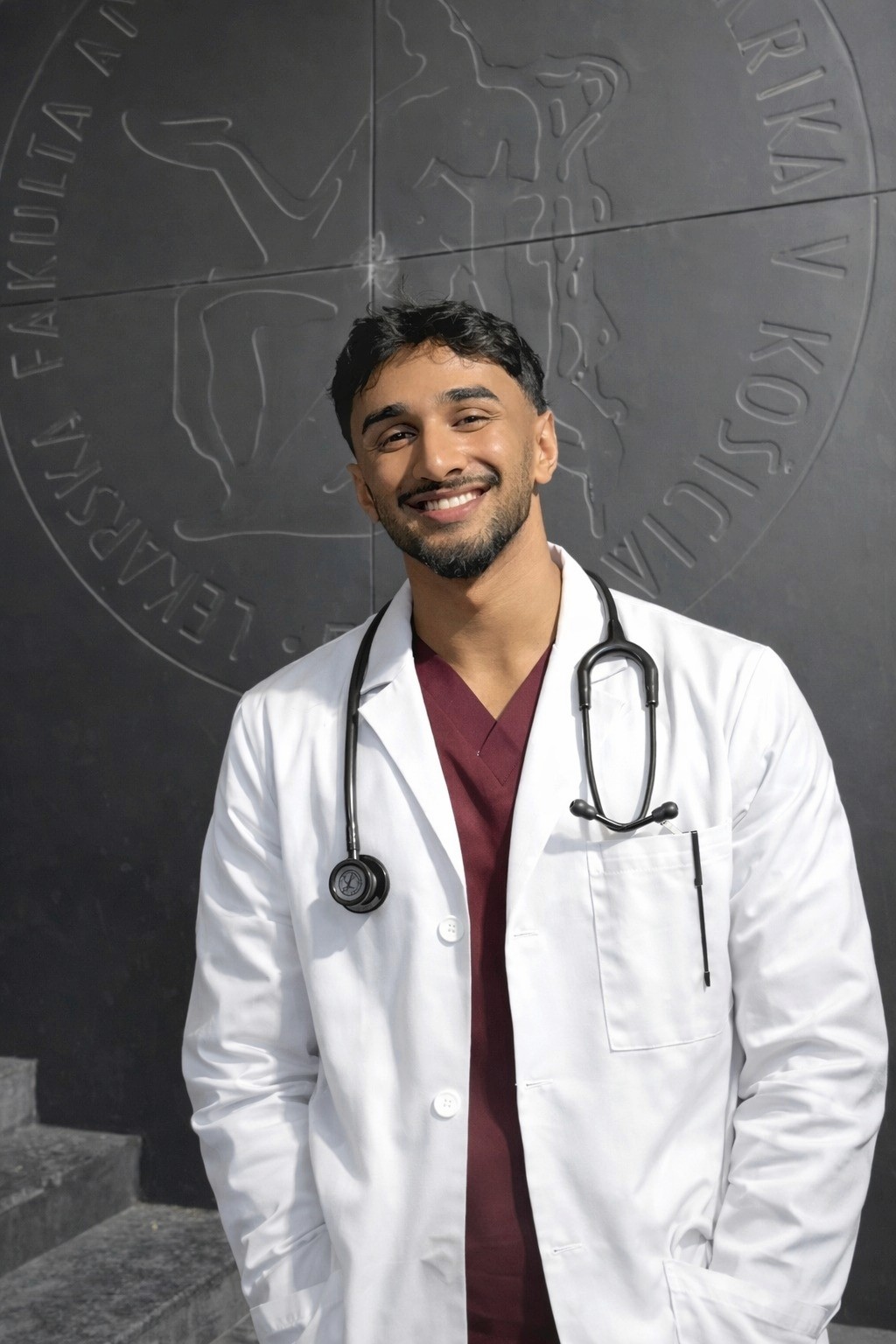
Yes — you can transfer from Semmelweis to UPJŠ Košice and continue your 6-year medicine degree, but it is not automatic. You still sit the UPJŠ entrance exam (Biology + Chemistry), then apply to have your completed Semmelweis subjects recognised, and the faculty decides which year you enter. Here's exactly how the transfer works.
Real talk: nobody transfers medical schools because everything's going great. If you're googling how to move from Budapest to Slovakia, something at Semmelweis isn't clicking — the exams, the cohort size, the money, the pace — and you want to know if there's a way out that doesn't torch the years you've already put in. I get it, because I've been through a transfer myself. So let's talk honestly about a transfer from Semmelweis to UPJŠ medicine: the real reasons students leave, what UPJŠ Košice does differently, and the actual rules, deadlines and documents involved. I'll be fair to Semmelweis the whole way, because it's a genuinely strong school — it's just not the right fit for everyone.
The move is real but not automatic: you sit the UPJŠ entrance exam first, then apply to have your Semmelweis subjects recognised, and the faculty decides which year you enter.
Why students actually leave Semmelweis
Let's start by giving Semmelweis its due. It launched English-language medical training back in 1989 (German in 1983), so it has over 40 years of international teaching behind it. It has almost 16,000 students, roughly a third of them from 129 countries across five continents, and more than 1,500 students graduate every year. That's not a diploma mill — that's a serious, historic medical university in the middle of a beautiful city.
But "serious and historic" cuts both ways, and here are the honest reasons people leave:
- The first two years are brutal — heavy anatomy, biochemistry and physiology, delivered fast, with oral exams where a single bad question can sink a whole semester's work.
- You can feel like a number — the English programme cohorts are large, and if you're the kind of student who does better with a smaller, more personal environment, that's a real problem, not a weakness.
- Hungarian schools have a relatively high dropout rate — across Hungarian universities the number of discontinued studies is notably higher than in many other European countries. That's a system-wide reality, not a Semmelweis-specific flaw, but it's why so many students end up researching a move.
- It's expensive — English-language General Medicine at Semmelweis runs about USD 10,450 per semester, roughly USD 20,900 a year, across a 6-year, 360-credit programme.
None of that makes Semmelweis "bad." It makes it demanding and pricey — and if you've fallen a couple of exams behind or you're burning out, "demanding and pricey" can turn into a spiral. That's the moment a lot of people start looking at UPJŠ.
The UPJŠ destination at a glance
Here is what you would be transferring into at UPJŠ Košice.
Košice, Slovakia: same MUDr., different environment
- Same degree shape: 6 years, 12 semesters, awarding the MUDr.
- Tuition €13,000 per year (2026/27), locked for the whole degree once you enrol
- Only 40 ECTS recognised needed to move from year 1 into year 2
- Transfers possible up to the 4th year for General Medicine
- Entrance exam: 200 MCQs in Biology and Chemistry, practice it free

What UPJŠ Košice does differently
Pavol Jozef Šafárik University (UPJŠ) in Košice, Slovakia, sits about 30 minutes from the Hungarian border and hosts over 1,000 international students on its Faculty of Medicine. Its English General Medicine programme is the same shape as Semmelweis's — 6 years, 12 semesters, awarding the MUDr. (Doctor of General Medicine) — so you're not downgrading your degree. What changes is the environment around it:
- A smaller international community — around 1,000 international students, which for a struggling student can be the difference between drowning and being seen.
- A gentler progression rule — to move from year 1 into year 2 at UPJŠ you need only 40 ECTS recognised. Plenty of medical schools make you clear the entire first year before you can progress; UPJŠ doesn't. If the Semmelweis pain point was "I have to pass literally everything," this is the fact that changes your life.
- Lower, fixed tuition — UPJŠ General Medicine is EUR 13,000 per academic year for 2026/27, and your fee is locked for the whole degree once you enrol — it doesn't creep up year to year.
- A calmer, cheaper city — Košice is a mid-size Slovak city with real student life and a lower cost of living than Budapest, which matters a lot when you're relocating on a student budget.
| Factor | Semmelweis (Budapest) | UPJŠ (Košice) |
|---|---|---|
| Tuition / year | ~USD 20,900 | €13,000 (2026/27) |
| Degree | MUDr., 6 years | MUDr., 6 years |
| City | Budapest, Hungary | Košice, Slovakia |
| Campus / intl. cohort | ~16,000 campus | ~1,000 intl. |
| Entrance exam | Written test + interview | 200 MCQs, Bio + Chem |
| EU recognition | Dir. 2005/36/EC | Dir. 2005/36/EC |
Can you actually transfer from Semmelweis to UPJŠ for medicine?
Short answer: yes, and transfers into the UPJŠ Faculty of Medicine are possible up to the 4th year for General Medicine and into the 1st or 2nd year for Dental Medicine, under a directive in force since 1 September 2022. But — and this is where the generic agency pages get vague — there are two distinct official processes and you shouldn't conflate them:
- Recognition of subjects — for anyone coming from a previous, unfinished study. You must first pass the UPJŠ entrance exam, then apply to have your completed Semmelweis subjects recognised by 15 September, submitting to the Study Department. The faculty then decides which subjects count and which year you enter.
- Transfer (registration) — for students in good standing who met every condition to continue into the next year (not interrupted, terminated or expelled). You submit a signed Request for Transfer by 15 August. You can't both apply for a regular transfer and sit the entrance exam for the same programme in the same year.
So no, it isn't "effortless from anywhere." The entrance exam is real. But if you're a solid student who just wants out of a school that isn't working, it's very doable — I'm proof.
The recognition rules, plainly
- Recency — a subject is only recognised if you completed it within the last 10 years (from the start of the academic year).
- Same-level source — it must come from another Faculty of Medicine at the same level, with the same or only slightly different programme. Semmelweis qualifies cleanly here.
- It must exist at UPJŠ — the subject has to be a compulsory or compulsory-elective in the UPJŠ curriculum.
- Grading has to match — a UPJŠ graded subject is recognised only if it was actually graded at Semmelweis, not marked pass/fail; a subject you merely "passed" tends to carry over as a bare pass rather than a full grade.
- Type of completion must match — a subject that ends in an exam can only replace a UPJŠ subject that ends in an exam. Grades A to E are accepted; only F is rejected.
- Unfinished studies only — you can't transfer credits from a study you already completed and got a degree for.
- The ECTS maths — 40 ECTS gets you into year 2, and at least 180 ECTS must ultimately be earned at UPJŠ itself.
If you're wondering whether this is unique to Hungary-to-Slovakia moves, it isn't — the same recognition framework is how students come across from schools like Poznań (PUMS) too, and it's the backbone of most medical and dental transfers between European universities.
The entrance exam you still have to sit
UPJŠ's entrance exam is 200 multiple-choice questions — 100 Biology and 100 Chemistry — over 2.5 hours. It's a fair, predictable test: no oral-exam roulette, no surprise interview panel. If you've already survived Semmelweis's first year, you know most of this material; it's about revising in the right format. We built free flashcards and practice questions specifically for it, so you walk in prepared.
Documents and fees for the UPJŠ transfer
UPJŠ is strict about paperwork — incomplete requests get rejected — so get this right the first time. Everything must be officially translated into Slovak or English. You'll need:
- Original transcript of records — with the exact completion dates for every course.
- Syllabi — original or certified syllabi of the courses you completed at Semmelweis.
- Proof of current student status — confirmation that you're an enrolled Semmelweis student in good standing (for the transfer route).
- The fees — a fixed recognition fee of €20, on top of an application fee of roughly €30. This is not where the cost lives.
Once you're accepted there's the usual enrolment admin on top — standard ID and prior-qualification paperwork — but that's exactly the kind of checklist we walk you through so nothing gets missed.
Košice vs Budapest as a student
Budapest is glorious and I won't pretend otherwise — but it's a capital city with capital-city prices. Košice is smaller, quieter and noticeably cheaper to live in: rent, groceries and going out all stretch a student budget further, which matters when you're already paying tuition. It's Slovakia's second city, so there's a genuine international student scene, and being half an hour from the Hungarian border means Budapest is still an easy trip when you miss it. For a lot of people the swap from "overwhelming and expensive" to "manageable and affordable" is a big part of why the move works.
Will a UPJŠ medical degree still count?
This is the fear that keeps people stuck at a school they've outgrown, so let me be clear. A UPJŠ MUDr. is a 6-year basic medical qualification listed in Annex V, point 5.1.1 of EU Directive 2005/36/EC — which means it's automatically recognised across the EU and EEA, entitling you to access the profession in any EU country, exactly like a Semmelweis degree. For Norway, that's autorisasjon via Helsedirektoratet. The UK is the one place that isn't automatic post-Brexit — doctors register with the GMC on a case-by-case basis — so if the UK is your endgame, plan for that specifically. I go deeper on all of this in our guide to EU medical degree recognition for the GMC and Norway.
My honest take — I've been there
I transferred myself, and several people on the Medently team transferred to UPJŠ Košice. What I'll tell you is that the hardest part wasn't the paperwork or the exam — it was admitting the current school wasn't working and giving myself permission to move. Once I decided, the process was mechanical: pass the exam, get subjects recognised, enrol. My one piece of tactical advice — transfer before the clinical years. Moving between years 2 and 3, before clinical coursework, keeps recognition clean; big moves into the clinical years hit prerequisite and sequencing problems (a Masaryk University transfer once tangled up over 30 students that way). Sooner is smoother.
And here's the Medently part: we guide the whole Semmelweis-to-UPJŠ transfer for free — no agency fees. We help you line up documents, prep for the entrance exam, and time the recognition request. You're not paying a middleman to do something you're allowed to do yourself; you're just doing it with people who've actually done it.
FAQ
Can you transfer from Semmelweis University to UPJŠ Košice for medicine?
Yes. You first pass the UPJŠ entrance exam (Biology + Chemistry), then apply to have your completed Semmelweis subjects recognised. The faculty decides which subjects count and which year of the 6-year MUDr. programme you enter. Transfers are possible up to the 4th year.
Up to which year can you transfer into UPJŠ?
Up to the 4th year for both General Medicine and Dental Medicine, under a directive in force since 1 September 2022. Transferring earlier — before the clinical years (between years 2 and 3) — keeps subject recognition much cleaner.
Does UPJŠ recognise credits and grades from Semmelweis?
Yes, within limits: the course must have been completed in the last 10 years, the type of completion must match (exam-for-exam), and grades A to E are accepted while F is rejected. You need 40 ECTS to reach year 2 and at least 180 ECTS earned at UPJŠ overall.
Is a UPJŠ medical degree recognised across the EU?
Yes. The UPJŠ MUDr. is listed in Annex V, point 5.1.1 of EU Directive 2005/36/EC, so it's automatically recognised across the EU and EEA, including Norway (autorisasjon via Helsedirektoratet). The UK is assessed case-by-case by the GMC post-Brexit.
Every Medently student gets free document handling, entrance-exam flashcards where there is an exam, and direct chat with current students at UPJŠ, UPOL, UMCH and RSU. No fees, no hidden costs.
Ready to apply to medicine or dentistry in Europe?
Talk to active students. 100% free advisory from Medently.
