If you're holding no medical school offers for 2026, you have three realistic moves: a gap year to reapply, a long-shot attempt at UCAS Clearing on 13 August, or starting an English-taught 6-year medicine degree in Europe this September. The European route skips the UCAT entirely, entrance exams run all through the summer, and you can still sign up. Our Study Medicine in Europe guide covers that third door in full.
The last UCAS decision dropped, your hub shows rejections across the board, and now you're typing things like no medical school offers 2026 what to do into Google at 2am. I know, because that was me. And most of what Google gives you back is either fluffy reassurance or someone quietly trying to sell you a £2,000 interview course.
So let me be the person I needed back then. I'm Lisa, I'm a medical student, and my UK application cycle ended with exactly zero offers. I now study medicine in Europe through the same route I'm about to walk you through, and these days I help other students figure this out at Medently. This post is the honest version: what clearing actually looks like, when a gap year genuinely makes sense, and how starting in Europe this September really works, with real 2026 numbers and sources for all of it.
First, breathe. The 2026 numbers were brutal for everyone
Before you spiral into "maybe I'm just not good enough", look at what you were up against. UCAS reported record demand for the October early deadline this cycle: 79,160 applicants, up 7.4% on the year before, with applications to medicine and dentistry up more than 12 per cent. By the 15 October deadline, 25,770 people had applied to study medicine in the UK for 2026 entry. They were competing for roughly 8,126 funded places.
Do that maths. Roughly one in four medicine applicants gets a place. Three out of four got the same news you did, and plenty of them had straight-A predictions, hospital volunteering and a personal statement their teachers loved. The UK system is a bottleneck of funded places. It is not a verdict on whether you'd make a good doctor.
You still have three realistic moves for 2026: the clearing lottery on 13 August, a gap year to reapply, or starting an English-taught 6-year medicine degree in Europe this September, no UCAT required.
Work out why it didn't work before you pick a fix
Every plan below depends on an honest diagnosis. Grab your feedback (some schools give it if you ask) and be blunt with yourself about which of these sank you:
- The UCAT: most rejections before interview come down to this one number. If your grades were fine but the UCAT wasn't, remember that for later, because the main European route never asks for it.
- Interviews: if you got MMI or panel invites and none converted, your academics are clearly fine. The fix is structured interview practice, not necessarily a whole new plan.
- Predicted grades: below the AAA zone, many UK schools filtered you out on paper before a human ever read your application.
- Personal statement and experience: rarely the sole reason, but thin work experience can drag down an otherwise decent application at statement-heavy schools.
The Medical Schools Council publishes how each school actually scores applicants, and it's worth an evening of your time before you commit to anything. Different schools weight the UCAT, grades and interviews completely differently, and most first-time applicants never checked.
No medical school offers in 2026: what to do next
Here's the full menu. Two UK routes, one European route, and two sideways moves. I'll give you the honest version of each, including the ones that have nothing to do with us.
Option 1: UCAS Clearing for medicine (the honest version)
Medicine clearing for 2026 opens on A-level results day, Thursday 13 August 2026. Every summer thousands of students convince themselves this is their way in, so here's what recent years actually looked like.
In 2025, only a handful of medical schools took clearing or late applicants. Newcastle appeared for home students only, with a same-day panel interview. Sunderland had a small number of places. Buckingham, which is private and priced accordingly, offered a January start. That was more or less the whole list. And nearly every school involved required a valid current-cycle UCAT score.
That last bit is the killer. If you didn't sit the UCAT for 2026 entry, or your score was the problem in the first place, medicine clearing is effectively off the table no matter how results day goes. And if your score was strong, the few places that do appear get swamped within hours by other strong applicants doing exactly what you're doing.
Real talk: treat clearing as a lottery ticket you check on 13 August, not as a plan. Have your grades and UCAT details ready, keep your phone charged, make the calls fast if something appears. Just make sure it's sitting on top of an actual plan, not instead of one.
Option 2: Take a gap year and reapply
This is the default advice from school careers advisers, and for some people it's genuinely right. A well-used year looks like this: rebook the UCAT and prepare properly this time (question banks, timed mocks, weeks of work rather than days), get paid or voluntary experience in a health or care setting, rebuild the personal statement around what you actually learned, and pick four schools whose scoring systems fit your profile instead of four famous names.
Now the honest part. Reapplying does not reset the odds in your favour. You'd be applying into the 2027 cycle on the back of a record year: applications to medicine and dentistry just rose more than 12 per cent, and UCAS counted 41,010 UK 18-year-olds applying for October-deadline courses, up from 38,940 the year before. Reapplicants with a visibly improved application do better than the average, but there is no version of this where a UK place is guaranteed.
On grades: if you missed your predictions, resitting is possible, but medical school resit policies vary wildly and some schools won't consider resit applicants at all without documented extenuating circumstances. Check the exact policy at every school you'd target before you build a year around this.
And count the real cost. It isn't just a delayed start; it's twelve months in application limbo with roughly a one-in-four base rate waiting at the end. If it works, brilliant. If it doesn't, you're two cycles behind friends who started somewhere in 2026, and you're reading this same article next summer.
Option 3: Start medicine in Europe this September (no UCAT)
This is the route I took, so I'll declare my bias upfront and then give you the facts anyway.
Long-established public universities across Europe teach medicine fully in English and admit students on a science entrance exam instead of the UCAT. Six years, ECTS credits, and an MUDr. degree (Doctor of General Medicine) at the end. The part most UK students simply don't know: admissions for September 2026 are still open. Entrance-exam sittings run all through the summer, and you can usually register up to about a week before a sitting. You have not missed the boat.
Medently works with four partner universities, plus NCU in Poland and UNIC in Cyprus, and the service is free. No agency fees, ever. We handle your application, register you for the entrance exam (any exam fee, like UPJŠ's €30, goes to the university, never to us), and walk you through to enrolment. The full landscape is in our Study Medicine in Europe guide; here are the three exam-based universities with their actual 2026/27 numbers.
The 3 exam-based universities at a glance
All three admit on a science entrance exam instead of the UCAT, and September 2026 admissions are still open.
Košice, Slovakia: exam on 12 August 2026
- General Medicine is 6 years, MUDr. degree
- €13,000 per year for 2026/27, locked the day you enrol
- English-taught for over 30 years, more than 1,600 international graduates
- Next in-person sitting: 12 August 2026 in Košice
- Practise free UPJŠ-style questions before your sitting

Olomouc, Czech Republic: sit the exam online
- General Medicine (MUDr.), 6 years at €12,500 per year, locked at enrolment
- Entrance test: biology and chemistry plus physics or maths
- Online exam option, sittings running into early August
- One of the oldest universities in Central Europe

Hamburg, Germany: the premium option
- 6-year English-taught medicine degree, physically in Germany
- Hamburg campus of Romanian state university UMFST Târgu Mureș
- €25,000 per year, locked like the others
- Medicine only, set online exam dates over the summer
UPJŠ Košice, Slovakia
Pavol Jozef Šafárik University in Košice, Slovakia's second city, has taught medicine in English for over 30 years and has more than 1,600 international graduates. General Medicine is 6 years (MUDr.) and tuition for 2026/27 is €13,000 per year, set out in the university's official Rector's Decision No. 3/2026 on fees. That fee is locked the day you enrol and never goes up mid-course.
Palacký University Olomouc (UPOL), Czech Republic
UPOL is one of the oldest universities in Central Europe, in Olomouc, a proper student city an hour from Brno. General Medicine (MUDr.) is 6 years at €12,500 per year, again locked at enrolment. The entrance test covers biology and chemistry plus physics or maths, admission is ranked on your score, and there's an online exam option, so you can sit it from your bedroom in the UK. UPOL is taking applications for September 2026 through the end of July, with exam sessions running into early August. Reading this later? Message us and we'll check what's open.
UMCH Hamburg, Germany
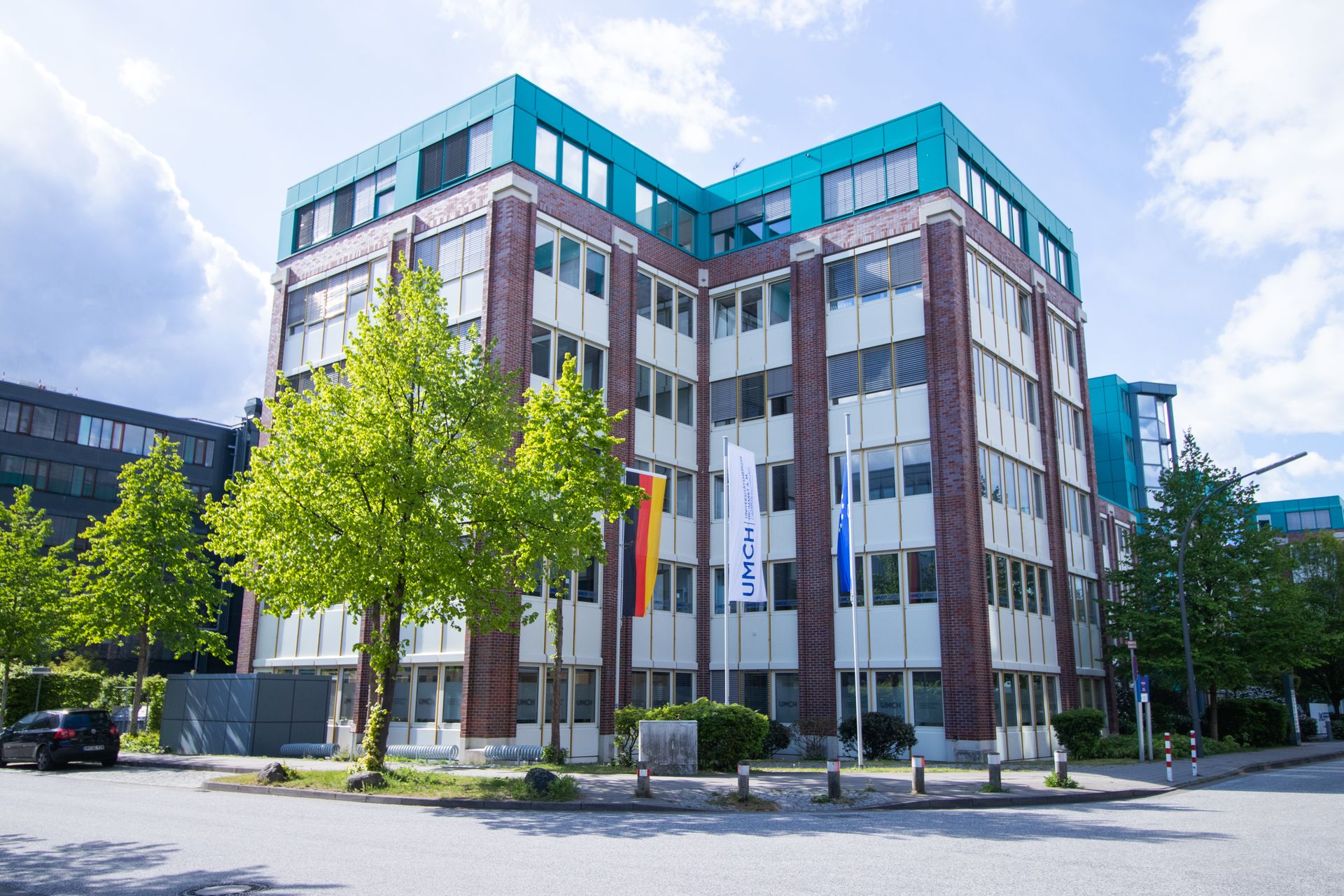
UMCH is the Hamburg campus of the Romanian state university UMFST Târgu Mureș: a 6-year English-taught medicine degree, physically in Germany. It's medicine only (no dentistry) and it's the premium option at €25,000 per year, locked like the others. Admissions run on set online exam dates over the summer; ask us which sitting is next on the calendar.
What the entrance exams are actually like
No UCAT. No abstract reasoning, no situational judgement, no verbal gymnastics. These are straight science exams. UPJŠ's is the one I know best: 200 multiple-choice questions, 100 biology and 100 chemistry, 2.5 hours, 800 points on the table, and recent pass levels have sat around 570 of 800 for medicine, so roughly 70 percent. The content maps closely onto A-level biology and chemistry, so if those were your strong subjects, you're preparing on home turf. (Didn't take both sciences? Read our post on studying medicine in Europe without biology and chemistry A-levels before you rule yourself out.)
On timing, and this matters: UPJŠ's next in-person sitting is 12 August 2026 in Košice. We even ran a sitting in Oslo on 20 July for Nordic students, and future cohorts get their own dates too. UPOL runs online sittings into early August. Registration stays open late, usually until about a week before a sitting, and Medently registers you for free and puts you on the next available date. There's very likely still a sitting with your name on it this summer, so there's no panic needed, just a few focused weeks of bio and chem revision.
"But can I come back and work for the NHS?" Yes. Here's exactly how
This is the question that stops most UK students, and it's the part almost every article fudges, so let's do it properly.
Inside the EU and EEA, recognition is automatic. EU Directive 2005/36/EC sets a harmonised minimum for basic medical training: at least five years of study and at least 5,500 hours of theoretical and practical training provided by or under the supervision of a university (that's Article 24). Qualifications meeting the standard and listed in the directive's Annex V are recognised automatically across EU member states, with no extra assessment of the degree. A 6-year MUDr. from Slovakia or Czechia clears that bar comfortably, which is why these graduates can work anywhere from Germany to EEA countries like Norway.
The UK is post-Brexit, so it has its own process, and it's a well-trodden one. Nothing is automatic with the GMC, but the GMC runs a dedicated full-registration route for doctors who hold what it calls a relevant European qualification. Per the GMC's own application guidance, a relevant European qualification is accepted as evidence of your knowledge and skills, which means graduates on this route are not required to sit the PLAB test. You still complete the GMC's standard registration checks like every doctor does, and then you apply for UK posts as a GMC-registered doctor alongside everyone else, UKMLA-era UK graduates included.
Now compare that with degrees from outside the European framework, the Caribbean and Georgian schools some agencies love to push. There, the GMC must first confirm your qualification is even acceptable before you can attempt PLAB or apply for registration, and it assesses qualifications case by case with no fixed list. Doable, but a genuinely different level of uncertainty. That's exactly why we only work with EU universities. The full UK picture, step by step, is in our post on whether a European medical degree is recognised in the UK.
Option 4: Graduate Entry Medicine (the long way round)
The plan here: do a biomedical science or similar degree first, then apply to four-year Graduate Entry Medicine courses, usually via the GAMSAT or another UCAT round. It's a real route, and it suits people who genuinely want another degree in its own right. But be clear-eyed about the shape of it. Three years of undergrad plus four of GEM means you'd qualify a year later than someone starting a 6-year European course this September, and that assumes the GEM application works first time against some of the fiercest competition ratios in UK higher education. As a backup plan it's slow and uncertain. As a genuine two-degree ambition, fair enough.
Option 5: Allied health and the honourable exits
Sometimes the right answer is that medicine was one option, not the only one. Physician associate courses, nursing, paramedic science, pharmacy, radiography: real clinical careers, shorter training, and NHS demand for all of them. If your motivation was "working in healthcare" more than specifically "being the doctor", these deserve real thought, not a consolation-prize shrug.
One quick cross-reference while we're here: if you were ever torn between medicine and dentistry, UPJŠ and UPOL both run 5-year English-taught dentistry programmes (MDDr.). Different degree, different UK regulator too, since dentists register with the GDC rather than the GMC, but the same September-start logic applies.
Reapply vs clearing vs Europe, side by side
| Question | Clearing 2026 | Gap year + reapply | Europe, Sept 2026 |
|---|---|---|---|
| When you'd start | Sept 2026, if a place appears | Sept 2027 at the earliest | Sept 2026 |
| When you'd graduate | Around 2031 | 2032 at best | 2032 |
| How certain is a place | Very low | Roughly 1 in 4 | High if you pass a science exam |
| Exam needed | Valid 2026 UCAT | New UCAT, maybe resits | Biology + chemistry test |
Look at the graduation years for a second. A gap year that works still lands you at the same finish line as starting in Europe now. A gap year that doesn't work costs you another full lap. When I finally wrote that down on paper, the decision stopped being emotional and started being obvious.
Which option fits which student
- Strong A-levels, the UCAT was the problem: Europe is close to purpose-built for you. The entrance exams test biology and chemistry, the things you're already good at, and the UCAT never enters the conversation.
- Missed your predicted grades: a resit year can make sense, but only after checking resit policies at your actual target schools. If most say no, Europe's exam-based admission weighs what you can do in the test far more heavily than your certificate history.
- Got interviews but no offers: you're agonisingly close on the UK route, so one well-prepared reapplication is defensible. I'd still sit a European entrance exam this summer as insurance. You're allowed to hold both plans at once.
- Already hold a degree: weigh GEM (GAMSAT, four-year course, brutal ratios) against starting a 6-year MUDr. this September. Run the maths on years and certainty, not on prestige.
- Not sure medicine is still the dream: that's allowed too. Look properly at allied health before spending years or money proving a point to your younger self.
Your late-July to September 2026 game plan
If Europe is your plan A (or your insurance policy)
- This week: pick your shortlist and start the free application. It takes minutes, we handle the paperwork with the university, and there are no agency fees.
- Next two to three weeks: revise biology and chemistry. Our free UPJŠ-style flashcards and practice questions mirror the real exam format.
- August: sit your exam, in person in Košice on 12 August for UPJŠ or online for UPOL, then get your result and enrol.
- September: flights, accommodation, orientation week. You're a medical student.
If you're playing the clearing lottery
- Before 13 August: confirm your UCAT score is valid for this cycle and know it by heart, because without one this route barely exists.
- Results day: phone charged from 8am, grades in front of you, list of numbers ready. Move fast if anything appears.
- Either way: pair it with another plan, because places are scarce and unpredictable by design.
If you're committing to the gap year
- Now: book UCAT prep and your test sitting for the new cycle, and start it like a job, not a hobby.
- August onwards: lock in healthcare or care-sector experience with actual patient contact.
- September to mid-October: rebuild the statement, choose four schools by scoring fit, and submit for the October early deadline.
FAQ
Can I study medicine in Europe without the UCAT?
Yes. English-taught programmes at universities like UPJŠ Košice and Palacký University Olomouc admit on a biology and chemistry entrance exam instead of the UCAT, with sittings running all through the summer. Medently registers you for a sitting for free.
Can I practise in the UK with a European medical degree?
Yes. The GMC operates a dedicated full-registration route for doctors holding a relevant European qualification, which it accepts as evidence of knowledge and skills, so no PLAB test is required on that route. You still complete the GMC's standard registration checks.
Is it too late to start medical school in September 2026?
No. Entrance-exam sittings run through the summer: UPJŠ sits in person on 12 August in Košice and UPOL runs online sittings into early August. You can usually register up to about a week before a sitting.
Can you get into medicine through UCAS Clearing in 2026?
It's possible but rare. Clearing opens on results day, Thursday 13 August 2026, and in 2025 only a handful of schools took clearing applicants, nearly all requiring a valid current-cycle UCAT score.
The bit I wish someone had told me
Zero offers feels like a verdict. It isn't. It's a bottleneck, and roughly three out of four UK medicine applicants hit it this year. A good number of them will still become doctors, just through a different door, and some of us will get there without losing a year to the reapplication casino.
Medently is free. No agency fees, no course to sell you. Saif, our founder, is a current med student, and co-founder Dr. Dylan is a working doctor; they built this because the agency world was full of fees and half-truths. If a reapplication genuinely looks like your better move, we'll tell you that on the call. And if Europe is right for you, we'll register you for a summer sitting, prep you for it, and walk you all the way to enrolment. Questions first? Drop us a message any time.
Every Medently student gets free document handling, entrance-exam flashcards where there is an exam, and direct chat with current students at UPJŠ, UPOL, UMCH and RSU. No fees, no hidden costs.
Ready to apply to medicine or dentistry in Europe?
Talk to active students. 100% free advisory from Medently.
